Most offices are busier than they've ever been. But busy doesn't always mean efficient.
Somewhere between the meeting that could have been an email, the approval that sat in someone's inbox for three days and the report nobody reads but everyone still produces - time and money leak out of your business every week.
You just can't see where it goes.
Lean methodology was built to fix exactly that. And it works just as well in an office as it does on a factory floor.
What Is Lean, in Plain Terms?
Lean is a management approach focused on one thing: eliminating waste.
Not cutting corners - eliminating the steps, processes and habits that consume time or money without delivering value to the customer.
It started in manufacturing.
Toyota built the Toyota Production System in the mid-20th century, and lean grew from that work. But the core idea transfers cleanly to any environment where work flows from one step to the next - which describes every office on the planet.
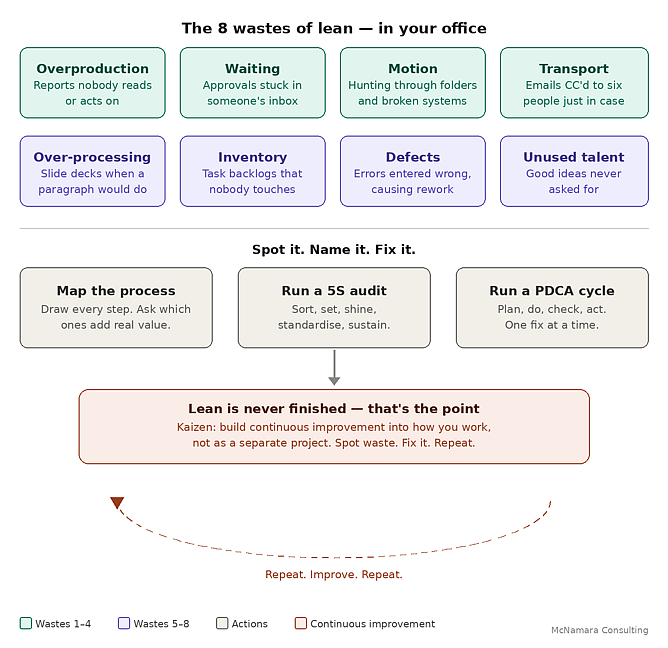
Lean defines waste in eight categories.
In a manufacturing context, these include defects and excess inventory.
In an office, they look different - but they're just as costly.
The Eight Wastes in an Office Environment
Understanding what waste actually looks like is the first step.
1. Overproduction - Creating reports, presentations or documents that nobody acts on.
2. Waiting - Staff sitting idle while they wait for approvals, decisions or information from someone else.
3. Motion - Unnecessary movement, including navigating poorly designed systems, hunting through shared drives or switching between too many tools to do one job.
4. Transport - Moving information between people or systems unnecessarily. Every email that CC's six people 'just in case' is an example.
5. Over-processing - Adding steps, sign-offs or formatting that the output doesn't need. Formatting a detailed slide deck when a two-paragraph summary would do.
6. Inventory - Backlogs. Tasks parked in inboxes, queues or to-do lists that sit untouched.
7. Defects - Errors that need to be corrected: wrong data entered, miscommunication that causes rework, forms filled out incorrectly.
8. Unused talent - Staff capable of solving problems but not empowered or asked to do so.
Look at your own week through that lens. Odds are you'll spot at least three or four of these before lunch on Monday.
Practical Ways to Apply Lean in Your Office
You don't need a consultant, a rebrand or a new piece of software to start. You need a few good questions and the willingness to act on the answers.
Map Your Processes First
Pick one process - onboarding a new client, processing an invoice, handling a staff leave request. Write down every step, including who touches it and how long each step takes. This is called a value stream map.
Then ask: which steps actually add value? Which ones exist because they've always existed?
Most teams find that 30–50% of the steps in a routine process add no value at all. They exist out of habit, caution or poor design.
Run a 5S Office Audit
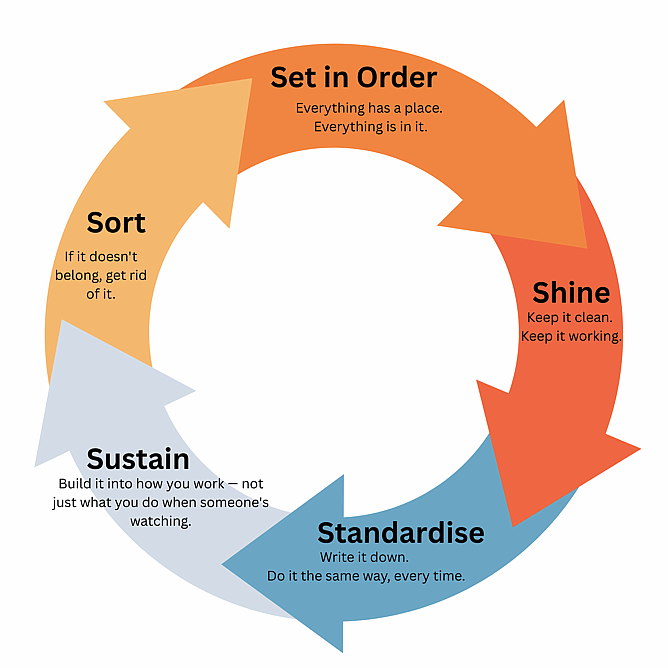
5S is a lean tool for creating organised, functional workspaces.
It stands for: Sort, Set in order, Shine, Standardise, Sustain.
In an office, this applies to shared drives, email folders, templates and physical workspaces alike. It sounds basic.
But a team that can find what they need in 30 seconds - instead of four minutes - recovers hours per week, per person.
Fix One Thing at a Time
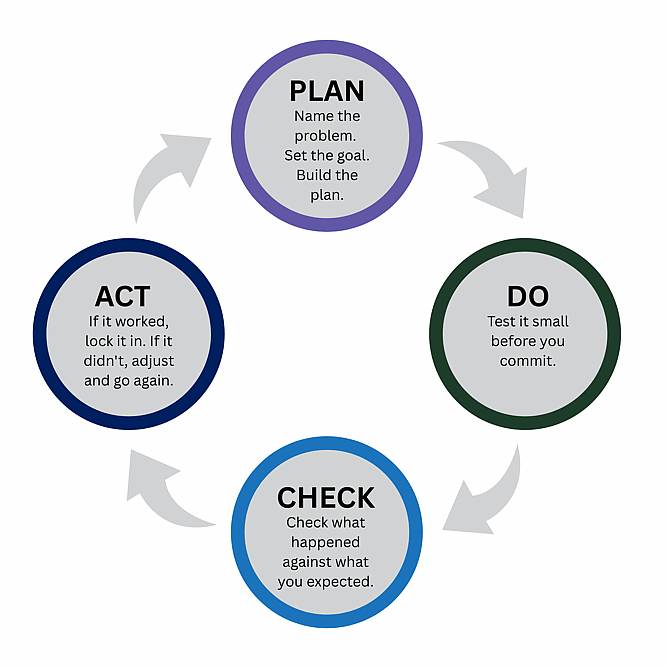
The instinct is to redesign everything. Resist it. Lean works best when you identify one specific problem, fix it, test the fix and measure the result. Then move to the next one.
This is called a PDCA cycle - Plan, Do, Check, Act. It's deliberately small and deliberate.
One improvement at a time, done properly, compounds into significant change.
Cut Your Meeting Waste
Meetings are one of the most expensive line items in any business - most organisations just don't account for them that way. Multiply the hourly rate of everyone in the room by the length of the meeting.
Now ask whether you got that value back.
Lean meeting discipline is simple: every meeting needs a clear purpose, a set end time and an owner. If it doesn't have all three, it shouldn't exist.
Lean Is Never Finished - That's the Point
This is the part most people miss.
Lean isn't a project you complete. You don't run a lean programme, tick it off and move on. The whole philosophy rests on the concept of kaizen - a Japanese word meaning 'continuous improvement.'
The idea is that no process is ever perfect, and the people closest to the work are best placed to spot where it could be better. A business that operates on lean principles builds improvement into how it works - not as a separate initiative, but as a habit.
This matters because the environment your business operates in never stops changing. Customer expectations shift. Technology changes what's possible. Staff turnover. Regulations update. A process that worked well 18 months ago may now be slower than it needs to be or built around a tool you no longer use.
Standing still isn't neutral. It's falling behind.
Why Continuous Improvement Matters Now More Than Ever
The pace of change in business has accelerated sharply. The businesses that adapt quickly are the ones that survive - and thrive.
Lean and continuous improvement give you a structure for that adaptation. Instead of waiting for a crisis to prompt change, you build regular review into your operations. You spot the slow leak before it becomes a flood.
For small and medium businesses, this is particularly important. You don't have the headcount to absorb waste. Every hour lost to a broken process is an hour not spent on growth, on clients or on the work that actually matters.
The organisations that treat improvement as ongoing - not occasional - make better decisions faster, respond to problems before they escalate and build teams that actually engage with their work. People who feel like their time is respected and their ideas count tend to stay.
Start Small. Start Now.
You don't need to overhaul your business to benefit from lean thinking. Start with one process. One waste you can name. One meeting you can shorten or cut.
Run the PDCA cycle. Measure what changes. Then do it again.
Over time, that discipline builds something most businesses talk about, but few achieve: a team that works efficiently, adapts quickly and improves without being pushed to.
This is the sort of stuff we can talk about all day, so give us a call if you are keen to start this journey.